c@rm3nre / September 8, 2026
Part 4 of 10: The real estate pain points costing small and mid-sized businesses money
Here’s an uncomfortable question worth asking before your next lease negotiation:
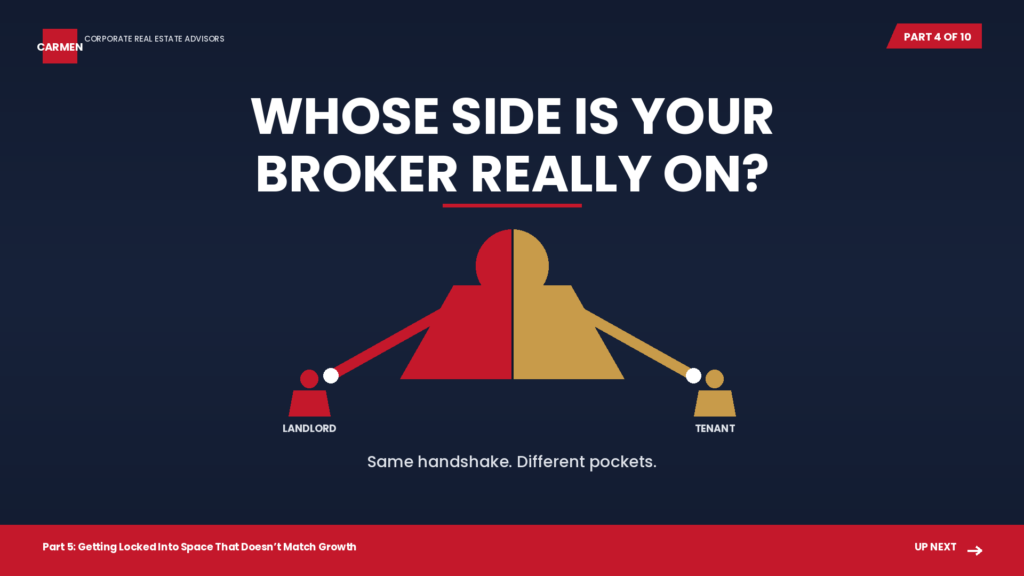
Who does your real estate broker actually work for?
The obvious answer is, “me.” And in most cases, your broker probably believes that too.
But commercial real estate has a structural issue that many business owners don’t fully understand. The same brokerage firm representing a tenant may also represent landlords, lease competing buildings, manage properties, pursue investment sales assignments, or have other relationships with the ownership groups sitting across the negotiating table.
That doesn’t automatically mean anyone is behaving improperly.
It does mean the incentives may not always be perfectly aligned.
The Problem Isn’t Necessarily the Broker. It’s the Business Model.
Large full-service commercial real estate firms are built to serve multiple sides of the industry.
They may represent tenants looking for space while brokers in the firm represent landlords trying to fill that space. They may advise occupiers while simultaneously pursuing leasing, property management, investment sales, financing, or other assignments from property owners.
There are procedures intended to manage conflicts when they arise.
But from the tenant’s perspective, there is still a reasonable question to ask:
If my objective is to secure the best possible economic and business terms from a landlord, does my advisor have any other business relationship—current or prospective—with that landlord?
For a large corporation with an experienced real estate department, this may be understood and carefully managed.
For the owner or CEO of a small or mid-sized company who negotiates a lease once every five or ten years, it may never even occur to them to ask.
Your Priorities Are Different From the Landlord’s
A landlord generally wants several things from a lease:
- Higher rent.
- Longer terms.
- Limited concessions.
- Strong credit.
- Minimal capital investment.
- Favorable renewal language.
- Reduced flexibility for the tenant.
The tenant often wants almost exactly the opposite.
- Lower occupancy costs.
- More free rent.
- Larger improvement allowances.
- Greater flexibility.
- Expansion and contraction rights.
- Favorable renewal options.
- Protection if the business changes.
Neither side is wrong. They simply have different objectives. That’s precisely why representation matters. You want the person advising you to approach every recommendation through one lens-the occupier / tenant:
What produces the best outcome for the occupier?
Transaction Compensation Can Create Another Misalignment
There is another issue business owners rarely think about.
Most traditional brokerage compensation is tied to completing a transaction.
No transaction, no commission.
Again, that does not make commission-based brokerage inherently bad. It has been the standard compensation model in commercial real estate for decades.
But incentives matter.
Sometimes the best advice for a business may be:
- Stay where you are.
- Reduce your footprint.
- Renegotiate rather than relocate.
- Delay a transaction.
- Sublease unused space.
- Exercise an existing option.
- Do nothing for another six months.
Those recommendations may produce less brokerage revenue—and often, none at all.
An advisor whose economic model depends primarily on completing transactions can therefore face a subtle tension between closing a deal and determining whether a deal should happen in the first place.
The distinction matters.
Advice Should Come Before the Transaction
THIS IS IMPORTANT: For most small to medium sized businesses, commercial real estate should not begin with the question:
“What space is available?”
It should begin with:
“What should our real estate strategy be?”
Before touring buildings or negotiating a renewal, management should understand:
- How much space the company actually needs.
- Whether employment growth justifies expansion.
- Whether hybrid work has changed utilization, and will it change again.
- What the company is currently paying compared with the market.
- Where opportunities exist to reduce occupancy costs.
- How much flexibility the business may need over the next five to ten years.
- Whether relocating creates enough economic or strategic benefit to justify the disruption.
- What leverage exists before negotiations begin.
Once those questions are answered, a transaction may follow….Or it may not.
That is an important difference between simply executing a real estate transaction and providing real estate advice.
Ask Better Questions Before Hiring a Broker
Most businesses perform significant due diligence before hiring an attorney, accountant, investment advisor, or consultant.
Real estate representation deserves the same scrutiny.
Before engaging a broker, ask:
Does your firm represent the existing landlord of any buildings we may consider?
Does your firm currently lease or manage properties owned by those landlords?
Are there other business relationships with the ownership groups we should know about?
How are potential conflicts handled?
How are you compensated?
And perhaps most importantly:
If the best recommendation is not to complete a transaction, will you tell us that?
The answers may not disqualify anyone. But management should understand the incentives of every advisor sitting at the table.
Alignment Is More Important Than Ever
Commercial real estate decisions can affect a company for years.
A slightly higher rental rate, an inadequate improvement allowance, poor lease renewal language, unnecessary square footage, or an inflexible lease structure can quietly cost hundreds of thousands of dollars over the life of a lease. I’ve seen the scenario many times over my 30+ years of exclusively representing tenants at CARMEN Corporate Real Estate Advisors.
Yet many small and mid-sized companies devote far less scrutiny to selecting their real estate advisor than they would to choosing an attorney, CPA, benefits consultant, or financial advisor.
That should change.
Your broker doesn’t have to be dishonest for incentives to matter. The better question is whether the structure surrounding the relationship encourages your advisor to make the same decision they would make if they were sitting in your chair.
Because when millions of dollars and years of contractual obligations are involved, “mostly aligned” isn’t quite the same thing as aligned.
Up Next — Part 5: Getting Locked Into Space That Doesn’t Match Growth
« Previous